
How to make a study schedule you'll actually follow
How to make a study schedule that sticks: work backward from the exam date, block real sessions, and build in review and slack so one bad day doesn't sink it.
To make a study schedule you'll actually follow, work backward from the exam date instead of forward from today, block realistic sessions you can finish, and build in review and slack so one bad day doesn't sink the whole thing. That's the short version. Most schedules fail because they're built the wrong direction and packed too tight to survive real life.
Here's the thing about study schedules: the problem is almost never motivation. It's design. A plan that assumes every day goes perfectly will break the first time you oversleep, get sick, or just have an off afternoon. So let's build one that bends instead.
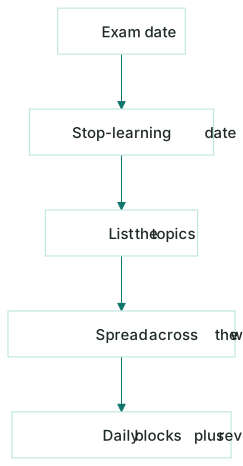
Start from the exam date, not today
Open a calendar and find the exam date first. Then count backward.
Going forward from today feels natural, but it has no finish line, so you drift. Going backward gives every week a job. You know exactly how much runway you've got, and you can see right away if you're trying to cram three weeks of material into one.
Do this:
- Mark the exam date. That's your anchor.
- Mark a "done learning" date a few days before it. The last stretch is for review and practice, not new material.
- List the topics you need to cover between now and that "done learning" date.
- Divide them across the weeks you have, heavier early, lighter near the exam.
This one flip, backward instead of forward, is what turns a vague "I should study more" into "I need to cover three topics this week." If you've got a big subject to get through, reviewing a whole subject before an exam walks through how to break it down without trying to re-read everything.
Block realistic sessions, not heroic ones
Now put actual sessions on actual days. The trap here is optimism. We plan for the person we wish we were, not the one who'll show up tired on Wednesday.
Keep blocks short and specific:
- 45 to 60 minutes per block is plenty. Long marathon sessions look productive on paper and fall apart in practice.
- One topic, one task per block. Not "study biology." Instead: "quiz myself on the nervous system" or "drill the cell-division flashcards."
- Name the task so it's already decided. When the block starts, you shouldn't have to figure out what to do. That decision is where procrastination sneaks in.
Vague blocks get skipped. Concrete ones get done. "Study chapter 4" is a wish; "take a hard quiz on chapter 4 and write down the misses" is a thing you can actually start and finish.
This is also where active study beats passive reading. A block spent re-reading feels like work but doesn't stick. That's why re-reading your notes doesn't work as well as it feels. Fill your blocks with retrieval instead: quizzing, recalling, explaining out loud.
Build review into the plan from day one
Most schedules treat review as something you'll "get to later." Later never comes, and you end up relearning topics you covered a month ago because they quietly faded.
The fix is to schedule review the same way you schedule new material. After you learn a topic, plan to revisit it a few days later, then again a week or so after that. Spacing it out like this is what makes it stick. It's the whole idea behind spaced repetition, and it's far more efficient than a single big cram at the end.
A simple rhythm that works:
- Learn a topic in one block.
- Quick review of it a few days later (10 to 15 minutes is fine).
- One more pass the following week.
- Final check in the review days before the exam.
You don't need an exact algorithm. Just make sure each topic shows up more than once, with gaps in between. The gaps are the point. Recalling something after you've started to forget it is what burns it in. That's the forgetting curve working for you instead of against you.
Leave slack so the plan can survive a bad day
This is the part almost everyone skips, and it's the most important one.
A schedule with no empty space is a schedule that breaks the first time life happens. You miss one block, fall behind, feel guilty, and quietly abandon the whole thing. Slack is what stops that spiral.
How to build it in:
- Leave one or two empty slots a week. Call them catch-up. If everything went fine, use them for extra review. If you fell behind, use them to catch up. No guilt, no cascade.
- Keep one weekend half-day open. A buffer for the week that goes sideways.
- Don't plan to study every single day. Rest days aren't laziness; they're what keeps you from burning out before the exam even arrives.
A plan you can recover from beats a perfect plan you abandon. Aim for "good enough that I keep going," not "flawless until it collapses."
A schedule that runs itself with one notebook
The other thing that quietly kills schedules: setup friction. If every block needs 20 minutes of prep before you can start, you won't start.
This is where keeping your material in one place pays off. Drop your notes, slides, or PDFs into a notebook per subject, and the study set is already there waiting. One notebook gives you several ways to study from the same files. So your blocks can just say:
- "Podcast pass on unit 3" (listen while you walk or commute, no screen needed).
- "Hard quiz on unit 3, log the misses." Quiz yourself before the exam does and find your gaps in a few minutes.
- "Drill the unit 3 deck." Flashcards are already built. You just flip and mark.
When the task is one tap away, the block actually happens. The schedule isn't fighting against setup time; it's just pressing play.
Putting your study schedule together
Here's the whole approach in one view.
| Step | What you do | Why it matters |
|---|---|---|
| Work backward | Start from the exam date, list topics across the weeks | Every week gets a clear job |
| Block sessions | 45-60 min, one topic, one named task | Concrete blocks get done |
| Build in review | Revisit each topic with gaps in between | Spacing makes it stick |
| Leave slack | One or two empty slots a week | One bad day doesn't sink the plan |
Make the schedule this week, not the night before. Write it somewhere you'll see it. And when a day goes wrong (because one will), use your slack, skip the guilt, and keep going. The schedule that wins is the one that's still standing the week before the exam, not the one that looked perfect on day one.
If actually starting is the hard part for you, how to stop procrastinating and start studying pairs well with this. A good schedule tells you what to do; that one helps you do it.
Frequently asked questions
- How do I make a study schedule that I'll actually stick to?
- Start from the exam date and work backward, not from today forward. Block specific sessions on real days, keep them short and concrete, and leave a couple of empty slots each week as slack so one missed day doesn't break the whole plan. A schedule you can recover from beats a perfect one you abandon.
- How far in advance should I make a study schedule?
- As soon as you know the exam date. Even a rough plan two or three weeks out beats a detailed one made the night before. The earlier you start, the more you can space your review out, which is exactly what helps things stick instead of leaking away.
- What should each study block actually contain?
- One topic and one active task, not 'study chapter 4.' Pick something you can finish in the time, like quiz yourself on one section, drill a flashcard deck, or listen through a podcast pass of one unit. Concrete tasks get done; vague ones get skipped.