Study tips for nursing students who are short on time
Study tips for nursing students who are short on time: small sessions, quick quizzes, and commute audio that fit study into a packed clinical week.
If you're a nursing student with almost no free time, the fix isn't finding more hours. It's using the small gaps you already have. Short quizzes between class and clinical, a flashcard run while you wait for a sign-out, audio on your commute. That beats one long evening of re-reading. This post lays out study tips for nursing students who are short on time, built around small consistent sessions instead of marathons.
Nursing school is its own kind of hard. The reading is enormous, the clinical hours eat your week, and the exams ask you to apply, not just recall. You can't out-read that schedule. What you can do is study in a way that fits between the cracks of your day.
The best study tips for nursing students start with small sessions
When your week is already full, the instinct is to save studying for one big block. That block rarely shows up, and when it does, you're exhausted. So the material piles up and the panic builds.
Small sessions solve two problems at once. They fit into time you actually have, and they space your contact with the material out over days instead of cramming it into one sitting. That spacing is what makes things stick. It's the spacing effect, one of the most reliable findings in learning science, and you can read more about it in spaced repetition: how to remember what you study.
Short sessions win for nursing content for another reason. The material is dense and interconnected, so your brain needs time between sessions to consolidate. Ten minutes today and ten tomorrow beats twenty minutes crammed into one tired hour.
If your attention tends to scatter when you're stretched thin, shorter sessions help there too. The same logic shows up in studying with ADHD: shorter sessions, more momentum.
Quiz yourself in the gaps, not at the end
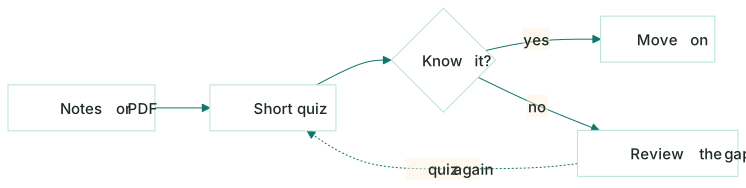
The single highest-value thing you can do with ten spare minutes is quiz yourself. Not re-read. Quiz.
Re-reading feels productive because the words look familiar, but familiarity isn't memory. When you pull an answer out of your own head, the effort is what builds the recall. This is the testing effect, and it's one of the strongest findings in the research (Roediger and Karpicke, 2006). There's a full walk-through in the testing effect: why quizzing yourself works.
Here's how to make it practical. Drop your lecture notes, a PDF handout, or a textbook chapter into a notebook in Kyonote, and it builds a short practice quiz from that exact material. The questions come at three levels: gentle to warm up, mixed once you're comfortable, and hard when you want to find the gaps before the exam does.
Run a quick quiz in the gaps your day already has:
- Between a lecture and your next class.
- Waiting for report or sign-out on the unit.
- The ten minutes before clinical starts.
- On a break when you'd otherwise scroll.
A wrong answer isn't a setback. It's the most useful thing a quiz gives you, because it points exactly at what to review next. For the full method, see quiz yourself before the exam does.
Turn your commute into a review session
If you drive or take the bus to campus and the hospital, that's review time you're leaving on the table. You can't read on a commute. You can listen.
From the same notebook, Kyonote turns your material into a podcast: two hosts talking through your notes in a back-and-forth that's easier to follow than a wall of text. Free episodes run up to 10 minutes and Pro goes up to 30. It plays like any audio player. Speed it up, skip back, keep it going in the background while your hands stay on the wheel.
The important part for nursing: the script comes from your own files, not the open internet. You hear your pharmacology deck or your med-surg notes. Not a generic explainer that drifts from what your instructor will test. For the walk-through, see turn any PDF into a podcast, and if your commute is the main thing you're trying to use, how to study on your commute, hands-free goes deeper.
Hearing the material and then recalling it later hits it two different ways, which is more durable than reading the same page twice.
Build flashcards once, drill them all week
Nursing has a lot you simply have to know cold: drug classes, normal lab values, signs and symptoms, the steps of a procedure. Flashcards are made for that, and the worst part has always been making them.
From your notebook, Kyonote builds a deck of short prompts straight from your notes, so you skip the hour of typing cards by hand. Then the way you study them is what counts. You read the prompt, try to answer from memory, then flip and mark "Got it" or "Again". That pause where you try to remember before flipping is the whole point.
A deck lives in your pocket, so you drill it in the same gaps you'd use for a quiz. Five cards at a bus stop is a real study session. If hand-making cards has been eating your evenings, flashcards that build themselves shows how to skip that step.
A realistic weekly rhythm
Here's a simple rhythm that fits a packed nursing week without asking for hours you don't have.
| When | What | How long |
|---|---|---|
| Commute | Listen to the podcast for the week's topic | 10 to 30 min |
| Small gaps in the day | Flashcards on the current deck | 5 min |
| Between class and clinical | Quick quiz, starting gentle | 10 min |
| Night before an exam | Re-listen, then a hard quiz on the gaps | 20 min |
The point isn't to do all of it every day. It's to have a default for each kind of free moment, so you stop deciding and just study.
Set up one notebook per course. Pharmacology in one, med-surg in another, so the material stays sorted by what you're actually being tested on. For more on keeping that tidy, see how to organize your study notes by notebook.
Protect yourself from burning out
Studying in the gaps only works if you don't also try to study every waking minute. Nursing students burn out fast, and a burned-out brain doesn't retain.
Small sessions help here too. They don't demand the deep willpower a three-hour block does. You're far more likely to do ten minutes than to talk yourself into an evening. Consistency beats intensity, especially over a long semester. There's more on staying steady in how to study hard without burning out.
Give yourself real breaks, and don't treat a missed session as failure. The rhythm is forgiving by design. Miss a day, pick it back up on the next commute.
Start with one notebook
You don't need to overhaul your whole system tonight. Pick the course with the next exam, make a notebook, and drop in your notes or a PDF. In about a minute you'll have a podcast for the commute, flashcards for the gaps, and a quiz for the ten minutes before clinical.
Then let the small sessions do the work. Short, often, and grounded in your own material is how you study for nursing school when you're short on time. It's far kinder than waiting for a free evening that never comes.
Frequently asked questions
- How can nursing students study when they have no free time?
- Use small, frequent sessions instead of long ones. A ten-minute quiz between clinical and class, a flashcard run while you wait, and a podcast on your commute add up fast. The trick is to make each gap of dead time a tiny bit of active recall rather than waiting for a free evening that rarely comes.
- What's the fastest way to review nursing notes before a shift or exam?
- Turn your notes into a quiz and run it cold. Drop your lecture notes or a PDF into a notebook in Kyonote, generate a short quiz, and answer the questions from memory. Quizzing surfaces what you've forgotten far faster than re-reading, so you spend your scarce time on the gaps instead of the parts you already know.
- Can I study nursing material on my commute?
- Yes. Turn your notes into a two-host podcast and listen on the bus, in the car, or walking into the hospital. It plays like any audio player with speed control and background play, so your hands and eyes stay free. It's grounded in your own files, so you're reviewing exactly what you'll be tested on.