
Spaced repetition: how to remember what you study
Spaced repetition means reviewing at growing intervals so it sticks. Here's why spreading reviews beats cramming, plus simple schedules to follow.
Spaced repetition is reviewing what you've learned at growing intervals instead of all in one sitting. You study something today, review it in a couple of days, again next week, then later still. Each review lands right as the memory starts to fade, and that timing is what makes it stick.
It sounds too simple to matter. But spacing your reviews is one of the most reliable study methods we have, and it's the opposite of how most people actually study. Here's why it works, and how to do it without turning your life into a spreadsheet.
What the spacing effect actually is
Psychologists call it the spacing effect: you remember more when your reviews are spread out over time than when they're crammed together, even if the total study time is the same.
This isn't a new or fringe finding. Hermann Ebbinghaus noticed it in the 1880s while testing his own memory, and it has held up across more than a century of research since. Spacing your practice beats massing it. Reliably.
The reason ties back to forgetting. Right after you learn something, the memory fades fast at first, then slower.
Here's the catch:
- Review while it's still fresh, and you barely have to work. You also barely learn anything.
- Wait until you've half-forgotten it, and dragging it back up is hard. That effort is what locks it in.
We've written more about that fade in the forgetting curve, and how to beat it. The short version: forgetting isn't the enemy. A little of it, at the right moment, is what does the work.
Why cramming feels good and fails
Cramming feels productive because the material gets familiar fast. You read the same chapter four times in one night and by the end it feels obvious. So you assume you know it. You don't.
That feeling is the trap. Familiarity is not the same as recall.
Reading a sentence and nodding along only proves you recognize it. It doesn't prove you could produce it on a blank exam page two weeks later.
This is also why re-reading is such a popular and weak method. It builds that comfortable feeling of "yeah, I've got this" while doing almost nothing for actual memory. We dug into that in why re-reading your notes doesn't work.
Spacing fights the trap from both sides. The gaps force you to actually retrieve, not just recognize. And by stretching the reviews across days, you catch the material at different points on the forgetting curve, which is when the work pays off most.
Spacing plus active recall: the real combo
Spacing tells you when to review. It doesn't tell you how. And the how matters just as much.
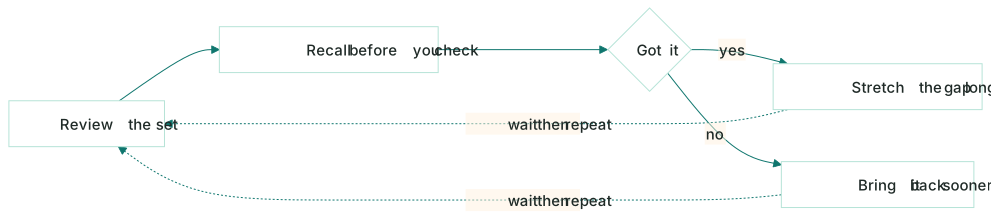
If you "review" by re-reading your notes on a schedule, you've spaced your reviews but kept the weakest study method. The fix is to pair spacing with active recall: instead of looking at the answer, try to produce it from memory first.
That moment of trying to remember, before you check, is the thing that strengthens the memory. It's called the testing effect. It's one of the best-supported findings in learning science (see the testing effect: why quizzing yourself works).
So the real method is two ideas stacked together:
- Spacing decides the timing: review at growing gaps.
- Active recall decides the method: retrieve from memory, don't re-read.
Flashcards happen to do both at once, which is why they pair so naturally with spacing. You see a prompt, try to answer it (recall), and a good system shows you the hard cards more often and the easy ones less (spacing). If you want the deeper dive on the recall side, active recall: the study method that actually works covers it.
Simple spacing schedules anyone can follow
You don't need an algorithm or an app to start. A rough schedule beats no schedule. The idea is always the same: review soon after learning, then stretch the gaps wider each time.
Here's a starting point you can adapt to how much time you have before your exam.
| Time until exam | When to review |
|---|---|
| 2+ weeks | Same day, then day 1, day 3, day 7, day 14 |
| 1 week | Same day, then day 1, day 3, day 6 |
| 3 days | Day 1, then a short review each morning |
| Tonight (last resort) | One focused pass, then a quick recall pass before sleep |
A few notes on using this:
- Don't aim for precision. Missing a day by a day won't ruin anything. The benefit comes from spreading reviews out at all, not from hitting exact intervals.
- Stretch the gaps as it gets easier. Material you recall instantly can wait longer. Material you keep fumbling should come back sooner.
- Keep each session short. Ten focused minutes of recall beats an hour of passive re-reading. Spacing works partly because it lets you study in small, repeatable doses instead of one exhausting block.
If even a rough schedule feels like too much to manage, that's worth saying out loud.
Most people don't quit spaced repetition because they stop believing in it. They quit because the upkeep is its own chore: making cards, tracking what's due, remembering to show up.
So the real fix is to make the upkeep small enough that you actually keep it.
Where this fits in a real study week
Spacing isn't a separate task you bolt on. It works best woven into what you're already doing.
Here's what that looks like around a single lecture:
- Same day: one quick recall pass while it's still fresh.
- A day or two later: pull up the same material and test yourself, no notes open, just try to produce it.
- End of the week: let it rest, then come back and run it again.
The trick is having something ready to test against without rebuilding it each time. That's where a study set earns its keep: a deck of flashcards or a short quiz you can run again and again on a stretching schedule. Make it once, reuse it across every spaced review.
This is exactly the gap Kyonote is built to close. You drop your lecture notes, a PDF, or your slides into a notebook, and it builds a flashcard deck and a practice quiz from that material in about a minute. The deck flips the way recall wants. You see a prompt, try to answer, mark Got it or Again, and the ones you find hard keep coming back. That "comes back more often" behavior is spacing doing its quiet work.
If you'd rather not build cards by hand at all, flashcards that build themselves walks through how that part works.
Common mistakes that quietly cancel the benefit
Spacing is forgiving, but a few habits will undo most of what it gives you. They're easy to slip into because each one feels reasonable in the moment.
- Spacing your re-reads instead of your recall. Opening your notes every few days is still spacing the wrong activity. Test yourself instead of skimming, or the gaps do little.
- Reviewing only what you already know. It's satisfying to run the easy cards. It's also a waste. Spend your gaps on the material you keep getting wrong, and let the easy stuff drift to longer intervals.
- Starting too late. Spacing needs room. You can't spread reviews across two weeks the night before. The single best thing you can do is start the same day you learn something, even if it's just five minutes.
- Marking too generously. If you only half-remembered a card, the honest move is to mark it for another pass. The cards you fudge are exactly the ones that'll surprise you on the exam.
- Making it a whole production. A spacing routine you can sustain for a month beats a perfect system you abandon after three days. Small and boring wins here.
Does spacing work for harder material?
Yes, and it's arguably where spacing matters most. Facts and vocabulary are the obvious case (capital cities, formulas, key dates). But the spacing effect holds for understanding too, not just rote memory.
For dense, conceptual material, the trick is what you space. Don't just re-test the definition. Instead:
- Space your attempts to explain the idea in your own words.
- Space your attempts to work a problem from scratch.
Coming back to a hard concept after a few days, struggling with it again, and getting it a bit cleaner each time is how real understanding forms.
It also pairs well with two other methods:
- Mixing related topics across your spaced sessions, instead of drilling one in isolation, helps you tell similar ideas apart.
- Explaining a concept plainly, then spacing those explanation attempts, turns a single review into a real test of whether you get it.
The point: spacing isn't only for memorizing. It's a timing strategy you can wrap around almost any active study method.
How to start spaced repetition without overthinking it
Spaced repetition rewards starting small more than it rewards a perfect system. So pick one subject this week and try this:
- Make one study set from your notes or a PDF. A deck, a quiz, or both.
- Run it today, the same day you learned the material.
- Run it again in two days, then again in a week, recalling before you check.
- Stretch the gaps for anything you keep getting right.
That's the whole method. Review at growing intervals, retrieve before you peek, and let the cards you find hard come around more often.
You won't remember everything forever. Nobody does.
But you'll remember a lot more of what you actually need, with less total time at the desk. That's the deal spaced repetition has been offering for over a hundred years. It still holds.
Frequently asked questions
- What is spaced repetition in simple terms?
- Spaced repetition means reviewing what you've learned at growing gaps in time instead of all at once. You review something today, then in a few days, then in a week, then later still. Each review comes just as you're starting to forget, which is the moment that strengthens the memory most.
- How is spaced repetition different from cramming?
- Cramming packs all your reviews into one block, so the material feels familiar but fades fast. Spaced repetition spreads the same reviews over days or weeks, which takes a little more patience but holds far longer. For an exam two weeks out, spacing wins almost every time.
- What's a simple spacing schedule I can follow?
- A common one is to review the same day you learn it, then after one day, three days, one week, and two weeks. You don't need to be precise. The point is to space reviews out and stretch the gaps as the material gets easier to recall.