
A calm plan for studying during finals week
How to study for finals week without the panic: triage your subjects, rotate them, protect your sleep, and quiz the gaps instead of re-reading everything.
The calm way to study for finals week is to stop trying to study everything. Triage your exams, rotate between them in short blocks, protect your sleep, and spend most of your time quizzing the gaps instead of re-reading the stuff you already know.
That's the whole plan. The panic during finals isn't really about the material. It's about the pile feeling infinite and not knowing where to start. So let's make the pile finite.
Study for finals week with triage, not a single subject
When five exams land in one week, the worst move is to open the first set of notes and start grinding. You burn a whole day on one subject and the other four stay scary.
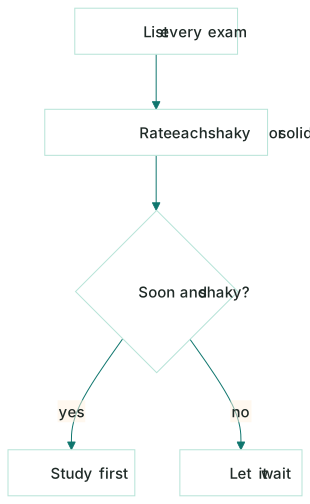
Do triage first. It takes ten minutes and it kills most of the dread.
- List every exam with its date.
- Next to each, rate how shaky you feel: solid, okay, or shaky.
- Rank by two things: how soon it is, and how shaky you are.
Now you have an order. The soon-and-shaky exams go first. The far-and-solid ones can wait, and you're allowed to feel fine about that.
This is also where you decide what to skip. You can't master everything in a week, and trying to is how people freeze. Pick the topics worth the most points or the ones the professor hammered, and let the long-tail stuff go. A clear "I'm not studying that" is calmer than a fuzzy "I should study everything."
Rotate subjects instead of grinding one
Once you have your order, don't sit on one subject for six hours. Rotate.
Work in short blocks (something like 30 to 45 minutes), then switch to a different subject. It feels less efficient. It isn't.
Mixing topics is called interleaving, and the research is consistent: it helps you learn to tell similar things apart and pick the right approach, which is exactly what an exam asks for. Grinding one subject lets you coast on autopilot; switching forces your brain to actually re-engage each time. Here's the full reasoning on why mixing topics helps you learn.
Rotating also keeps you sane. Six straight hours of organic chemistry breaks people. Two hours of chem, then a switch to history, then back, is far more sustainable across a long week.
Quiz the gaps, don't re-read everything
Here's the trap of finals week. Re-reading your notes feels like studying, but it's mostly building a false sense of knowing. The words get easier to read each pass, and your brain reads "easy" as "I know this." You don't. You just recognize it.
The fix is to test yourself instead.
- Close the notes and try to recall the answer from a blank page.
- Use flashcards, but actually try to remember the back before flipping.
- Take a short practice quiz and see what you miss.
This works because of the testing effect: pulling information out of your memory strengthens it far more than putting it back in by re-reading. Roediger and Karpicke (2006) found students who tested themselves remembered much more a week later than students who just re-studied. And the re-readers felt more confident the whole time. That confidence gap is the whole problem during finals. More on this in the testing effect and why re-reading your notes doesn't work.
A quiz does something re-reading never can: it shows you exactly what's shaky. During finals, that's gold. You stop spreading attention evenly and start pouring it into the misses, which is where your grade actually moves.
Protect your sleep: it's not optional
The all-nighter feels heroic. It's a bad trade.
Sleep is when your brain files what you studied during the day into long-term memory. Skip it and you don't just feel tired. You lose a chunk of the learning you stayed up to get. Then you walk into the exam slower, foggier, and worse at recall.
So treat sleep as part of studying, not the thing you sacrifice for it:
- A short, focused session plus a full night beats a long groggy one.
- Don't cram right up to lights-out. Give your brain a buffer.
- If you're choosing between one more hour of re-reading and an hour of sleep, sleep wins.
Same logic applies to the basics people drop under stress: eat, drink water, get outside for ten minutes. A panicking, exhausted brain is a slow brain, and finals week is the worst time to be slow.

Build a loose day plan (not a rigid one)
A rigid hour-by-hour schedule looks great and survives until about 10am. Then one block runs long, you fall behind, and the guilt spiral starts.
Plan loosely instead. A finals day is really just a few rotations:
- Morning: the soonest-and-shakiest subject, in two short blocks with a break between.
- Midday: switch subjects. Eat. Move a little.
- Afternoon: a quiz on what you did in the morning. Find the gaps, review only the misses.
- Evening: light pass on tomorrow's exam, then stop early enough to sleep.
The point isn't to fill every minute. It's to make sure each day has retrieval in it, rotates subjects, and ends with sleep. If you want a steadier version of this for the whole stretch, see how to make a study schedule you'll actually follow. And if the panic is really about starting at all, how to stop procrastinating and actually start studying is the one to read.
The fastest way to calm down: see where you stand
Most finals-week panic is just uncertainty. "I don't know any of this" is a feeling, not a fact, and it's almost always exaggerated.
A quick self-test turns the feeling into a fact. Suddenly it's not "I'm doomed," it's "I've got the first three topics, the fourth is shaky, and the fifth I haven't touched." That's a to-do list. To-do lists aren't scary. Vague dread is.
This is the part where the setup usually breaks down. Writing flashcards and building practice quizzes is real work, and nobody has time for it in finals week. That's where Kyonote helps. You make a notebook per subject, drop in your PDFs, lecture notes, and slides, and from that one notebook it builds the stuff this plan runs on:
- Flashcards that build themselves, so you can run active recall without spending an hour typing cards.
- A practice quiz at three levels (gentle, mixed, hard), so you can see your gaps in five minutes instead of guessing.
- A two-host podcast of your notes for the walk between exams, so even your commute counts.
Everything stays grounded in your own notes, not the open internet, so you're practicing on exactly what you'll be tested on. Finals week doesn't have to feel like drowning. Triage, rotate, quiz, sleep. Let the busywork build itself while you focus on the parts that move your grade.
Frequently asked questions
- How do I study for multiple finals at once?
- Triage first. List every exam, mark how soon it is and how shaky you feel, and rank by soonest-and-shakiest. Then rotate between subjects in short blocks instead of grinding one to death. Mixing topics is uncomfortable but it helps you tell similar material apart, which is exactly what finals test.
- Should I pull an all-nighter during finals week?
- No. Sleep is when your brain files what you studied into long-term memory, so an all-nighter trades the one thing that locks in learning for a few more low-quality hours. You'll recall less and think slower in the exam. A short focused session plus a full night beats a long groggy one almost every time.
- How do I stop panicking during finals week?
- Panic usually comes from not knowing where you stand. A quick self-test fixes that fast: it turns a vague 'I don't know any of this' into a specific list of what's solid and what's shaky. Once you can see the real gaps, you have a plan instead of a feeling, and the dread drops.