
How to use flashcards and audio to learn a language
How to use flashcards and audio to learn a language: build vocab decks from your own material, space your reviews, and listen so the words go in two ways.
To learn a language with flashcards and audio, you drill vocabulary on cards, space those reviews out over days, and listen to the same words in real sentences so they go in through your ears too. Cards teach you the word; audio teaches you how it sounds and gets used. Together they cover more than either does alone.
The trick most people miss is the material. Generic decks and random podcasts are fine. But the words that stick best are the ones from what you're actually studying: your textbook chapter, your class handout, the article your teacher assigned.
Why flashcards work for vocabulary
Flashcards are a near-perfect fit for vocab because vocab is mostly pairs. One side has the word, the other has the meaning, and your job is to connect them on demand.
The reason cards beat re-reading a word list is that they force recall. When you flip a card, you have to produce the answer from memory before you check it. That act of pulling, not just seeing, is what the testing effect is about. Recognizing a word in a list feels like knowing it. Saying it cold, with the card face-down, is the real test.
There's a catch worth naming. It's easy to learn a word one direction and not the other. You might see "manzana" and think "apple" instantly, then freeze when you need to say "apple" in Spanish. If your goal is to speak, make cards that test both ways, or at least the harder direction.
Why audio is the missing half
A word on a card is flat. You know what it means, but not how it sounds. Where the stress falls, how fast it's said, how it blurs into the words around it.
That's the gap audio fills. Hearing the same vocabulary inside real sentences teaches you the part the card can't: rhythm, pronunciation, and how the word actually behaves in the wild. This is a version of dual coding, where the same idea comes in through two channels and leaves two traces instead of one.
Listening also fixes a problem cards quietly create. On a card, every word stands alone. In speech, words run together, and a word you "know" can fly right past you. Hearing it in context closes that gap.
Space your reviews so the words stay
Learning a word once is easy. Keeping it is the hard part, and that's where spacing comes in.
Left alone, new vocabulary fades fast. This is the forgetting curve at work, and it's brutal for language because there's so much to hold. The fix is spaced repetition: review a word just as you're about to forget it, and each review pushes the fade further out.
In practice this means short, frequent sessions beat one long one. A few minutes of cards every day will plant more vocabulary than a two-hour binge on the weekend. The cards you find easy, you see less often. The ones you keep missing come back sooner.
Two honest habits make spacing actually work:
- Keep new words small. It's tempting to add fifty at once. Don't. A smaller daily batch you keep reviewing beats a big one you abandon.
- Mind your review pile, not your streak. If reviews are stacking up faster than you clear them, you added too fast. Slow the new words until the backlog drains.
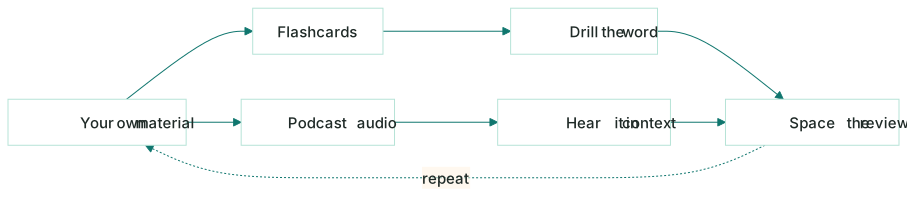
How to use flashcards and audio from your own material
Here's where most language study leaks time. You finish a chapter, then you go hunt for a deck someone else made, or you copy words into cards by hand one at a time. Both are slow, and neither matches exactly what you're being taught.
A faster loop is to build the deck straight from the material you already have. Drop your chapter, your vocab list, or your class handout into a notebook, and let Kyonote make the flashcards automatically. The deck is grounded in your file, so the words are the ones from your course, not a stranger's.
Then close the loop with sound. From the same notebook, you can turn that material into a short podcast: a two-host conversation built from your file, where your vocabulary shows up in real sentences you can hear. Now the words you're drilling on cards are the same words you're hearing in context. Two ways in, from one notebook.
This is the part that's easy to skip and shouldn't be. When your cards and your listening come from the same source, they reinforce each other instead of pulling in two directions.
A simple weekly loop
You don't need an elaborate system. Here's a rhythm that uses both halves without taking over your day.
| When | What you do | Why it helps |
|---|---|---|
| New material day | Build a deck from the chapter, learn a small batch | Cards plant the words |
| Every day after | A few minutes of card review | Spacing keeps them |
| On a walk or commute | Listen to the episode from that notebook | Audio adds context and sound |
| Before a test | Run through the deck once more, listen again | A final pass, both ways |
Notice that nothing here is long. The point isn't marathon sessions. It's short, repeated contact with the same words, through two channels, spread across the week.
If you study on the move a lot, the audio half is a gift, because you can listen to your notes on the go when reading isn't possible. Dead time on a bus becomes review time.
What to keep in mind
A few honest limits, so you set the right expectations.
Cards and audio are mostly for vocabulary and listening. They won't, on their own, make you fluent in speaking or fix your grammar. You still need to produce the language: write sentences, talk to people, get things wrong out loud. Treat cards and audio as the input engine, and speaking practice as the output.
Also, no tool grades your accent or guarantees a result. Kyonote builds the deck and the audio from your material so you can drill and listen. The actual learning is the reps you put in.
That's the whole method. Learn the word on a card, hear it in a sentence, and come back to it before you forget. Do that with your own material, a little each day, and the vocabulary stops slipping away.
Frequently asked questions
- Do flashcards actually work for learning a language?
- Yes, for vocabulary and set phrases especially. Flashcards make you pull the word from memory instead of just recognizing it, which is what testing yourself does best. They work even better when you space the reviews out over days rather than cramming them all at once.
- How many new words should I learn a day?
- A common starting point is around ten to twenty new words a day, but the honest answer is fewer than you think. It's better to add a small number you actually keep reviewing than a big pile you abandon. Watch your review load, not just your new-word count, and slow down if reviews start piling up.
- Is listening or flashcards better for vocabulary?
- They do different jobs, so pairing them beats picking one. Flashcards drill the word and its meaning so you can recall it on demand. Listening puts that word back in real sentences, with rhythm and context, so you learn how it actually gets used. Use cards to learn the word and audio to hear it live.