
Anki vs Kyonote: power-and-setup vs. zero-setup
Anki vs Kyonote, compared honestly. Anki is free, powerful, DIY flashcards. Kyonote auto-builds cards, a podcast, and a quiz from your notes. Which fits you?
Anki vs Kyonote comes down to one thing: how much building do you want to do? Anki is a free, hugely powerful flashcard app where you build and tune everything yourself. Kyonote is a mobile study app that auto-builds flashcards, a podcast, and a quiz from your notes with almost no setup. Anki rewards effort and control. Kyonote trades some control for speed.
So this isn't a "who wins" post. It's a "which one matches how you actually study" post.
Both tools change. Anki has a big ecosystem of add-ons and shared decks, so treat any specific feature here as "check the current version".
The 30-second version
- Anki is free, open-source, and built around a tunable spaced-repetition algorithm. You make your own cards (or import shared decks), and you can customize almost everything. The tradeoff is setup and a learning curve.
- Kyonote is a study app for your phone. You make a notebook, drop in PDFs or notes, and it builds a study set: flashcards, a two-host podcast, an audiobook, a quiz, and a mock exam, all grounded in your files.
- Anki is the specialist tool for spaced repetition. Kyonote is the fast path from "I have notes" to "I have something to study with".
- Both keep you inside your own material. Neither pulls answers from the open web.
The real split is time and control. Anki gives you total control if you put in the work. Kyonote gives you a study set in about a minute if you'd rather skip the building part.
What Anki is genuinely great at
Anki has earned its reputation. If you want the strongest version of spaced repetition, this is the tool people reach for.
- The SRS algorithm. Anki schedules each card based on how well you knew it, so you review things right before you'd forget them. That's the spaced repetition idea done seriously.
- It's free and open. Free on desktop and Android, with an add-on ecosystem for almost anything.
- Total customization. Card templates, deck options, scheduling tweaks, fonts, you name it. Power users can shape it exactly how they want.
- Shared decks. For some subjects there are huge community decks you can download instead of starting from scratch.
If you're the kind of person who enjoys tuning a system and you have a long horizon, like med school or a language over years, Anki is hard to beat.
Where Anki asks a lot of you
Here's the honest part. Anki's power comes with friction.
- You build the cards. Typing out every prompt and answer takes time, and the cards are only as good as how you wrote them.
- There's a learning curve. Deck options, intervals, card types. It can feel like configuring software before you study.
- Card-writing is a skill. Bad cards (too long, two facts in one) make reviews painful. Getting good takes practice.
- It's flashcards, mostly. Anki is a card tool. If you also want to hear your material or take a practice exam, that's on you to set up elsewhere.
None of this is a knock. It's just the cost of a tool that does one thing deeply. Some people love that cost. Some people bounce off it.
If making cards by hand is the part that stops you, that's worth naming. It's the single most common reason people abandon a deck.
Where Kyonote fits
Kyonote starts from a different question: what if the study set just built itself?
- You make a notebook for a subject or exam, then drop in your PDFs, lecture notes, or slides.
- In about a minute, you get flashcards that build themselves from your material, no typing required.
- You flip each card and mark Got it or Again, the same simple loop Anki uses, minus the building.
- You also get a two-host podcast from your notes, an audiobook, a quiz at three difficulty levels, and a mock exam, all from that one notebook.
The big difference: with Anki, you decide everything and do the work. With Kyonote, the set appears and you start reviewing. You give up some control over exactly how each card is worded, and you don't get Anki's deep scheduling controls. In return, you skip the setup entirely.
It's also built mobile-first, so making and reviewing happens on your phone, including hands-free audio for your commute.
Side by side
| Anki | Kyonote | |
|---|---|---|
| Cost | Free on desktop and Android; iPhone app historically paid (check current) | Free to start on iOS and Android, optional Pro |
| Who makes the cards | You (or shared decks) | Auto-built from your notes |
| Setup | Real learning curve | Drop in a file, set in about a minute |
| Spaced repetition | Tunable SRS, its core strength | Flip and mark Got it / Again |
| Beyond flashcards | Flashcards focused | Podcast, audiobook, quiz, mock exam too |
| Customization | Very deep | Light, opinionated defaults |
| Platform | Desktop-first, mobile apps exist | Mobile-first |
Treat the specifics as a starting point and check each tool's current version, especially pricing.
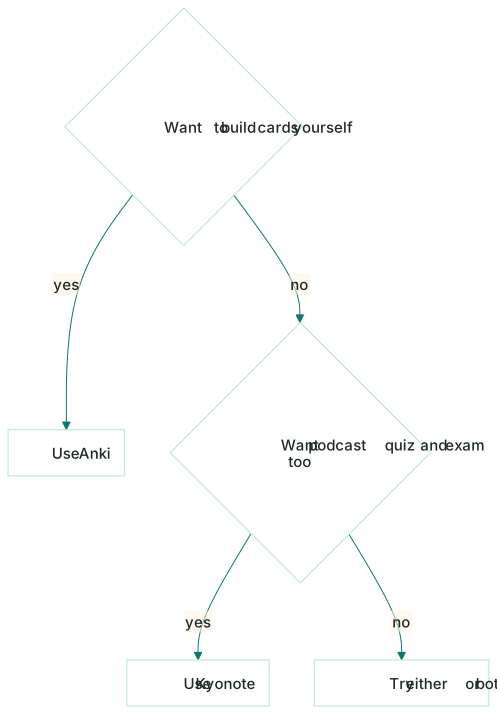
Anki vs Kyonote: which one should you use
Pick based on how you actually work, not which is "better".
Go with Anki if:
- You want the strongest, most tunable spaced-repetition system and you'll invest the time.
- You like control and don't mind a learning curve.
- A great shared deck already exists for your subject.
- You're in it for the long haul (years, not weeks).
Go with Kyonote if:
- You want a study set from your notes fast, without building cards.
- You'd also like a podcast, a quiz, or a mock exam from the same material.
- You mostly study on your phone, sometimes hands-free.
- The card-making step is the thing that keeps stopping you.
Honestly, some people use both: Anki for a long-term deck they care about, Kyonote when they just want to turn this week's lecture into something to review tonight. They're not enemies.
If you're still deciding how to study at all, start with active recall, the method both tools are built on. The tool matters less than actually quizzing yourself.
The short version: Anki is power-and-setup. Kyonote is zero-setup with extras. Choose the one that gets you reviewing instead of fiddling.
Frequently asked questions
- Is Kyonote a replacement for Anki?
- Not exactly. Anki is a free, deeply customizable spaced-repetition app where you build and tune your own cards. Kyonote auto-builds flashcards plus a podcast and a quiz from your notes with almost no setup. If you love control, Anki wins. If you want a study set fast, Kyonote fits better.
- Does Anki cost money?
- Anki is free on desktop and Android, and the official iPhone app has historically been a paid one-time purchase. Check Anki's current pricing, since that can change. Kyonote is free to start on iOS and Android with an optional Pro plan.
- Can Kyonote do spaced repetition like Anki?
- Anki is built around a tunable spaced-repetition algorithm, which is its main strength. Kyonote gives you auto-built flashcards you flip and mark Got it or Again, plus quizzes and a mock exam. If a fine-grained SRS schedule is the whole point for you, Anki is the specialist.