Flashcards that build themselves
Making flashcards is half the work — and the half people skip. Here's how Kyonote builds a deck straight from your files, and how to actually use it.
Making cards is the boring part
Everyone agrees flashcards work. Almost nobody makes them. Typing out a hundred question-and-answer pairs the night before an exam is exactly the kind of busywork you'll find a reason to avoid.
So Kyonote makes them for you.
A deck from your files
Point Kyonote at a notebook (lecture notes, a PDF, your own scribbles) and it pulls the key terms and ideas into a deck. Each card is a small, answerable prompt, not a paragraph. You open the app and there's a stack waiting.
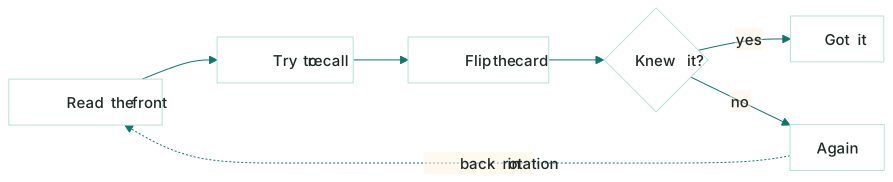
Then you just go through it:
- Read the front.
- Try to answer it in your head.
- Flip it.
- Tap Got it or Again.
That little moment of trying to remember before you flip is the whole point. It's called retrieval practice, and it's one of the most reliable ways to move something from "I've seen this" to "I know this."
How to use it well
- Short sessions, often. Five minutes between classes beats an hour the night before.
- Be honest with "Again." If you only half-knew it, mark it again. The cards you find hard are the ones worth seeing more.
- Pair it. Run the deck, then take a quick quiz from the same notebook to see what held up under pressure.
The best deck is the one that actually exists. Drop in your notes and let Kyonote build it.
Frequently asked questions
- How does Kyonote make flashcards?
- Point Kyonote at a notebook — lecture notes, a PDF, your own scribbles — and it pulls the key terms and ideas into a deck. Each card is a small, answerable prompt rather than a paragraph, so you can actually drill it.
- What do 'Got it' and 'Again' do?
- After you flip a card you mark whether you knew it. 'Got it' moves on; 'Again' keeps the card in rotation so the ones you find hard come back more often. Be honest with 'Again' — the cards you half-know are the ones worth seeing again.
- How should I study a deck?
- Short sessions, often. Five minutes between classes beats an hour the night before. Read the front, try to answer before you flip, then mark it — that moment of trying to remember is the part that makes it stick.