
How to organize your study notes by notebook
Organize your study notes by notebook — one per subject or exam — so the source stays tidy and every podcast, deck, and quiz you build stays grounded.
To organize your study notes by notebook, keep one notebook per subject or per exam, and put only that material inside it. That single habit keeps your source tidy. And when your source is tidy, everything you build from it stays grounded in exactly what you're being tested on.
Most note chaos isn't a willpower problem. It's a filing problem. You take good notes, then they pile up across folders, apps, and screenshots until you can't find the one page you need the night before a test. The fix isn't more notes. It's a clear place for each thing to live.
Why one notebook per subject (or per exam)
A notebook is a scope. When you open it, you should know exactly what's inside and what isn't.
One per subject works if you want the whole course in one place all term: every lecture, every handout, building up week by week. One per exam works if you'd rather keep things tight and only gather what's actually on the test. Both are good. What's not good is one giant pile labeled "school" where biology, history, and your group-project notes all blur together.
The test for a healthy notebook is simple: could you describe its contents in one short phrase? "Organic chemistry, this semester." "Finals: constitutional law." If the honest answer is "uh, a bunch of stuff," it's time to split it.
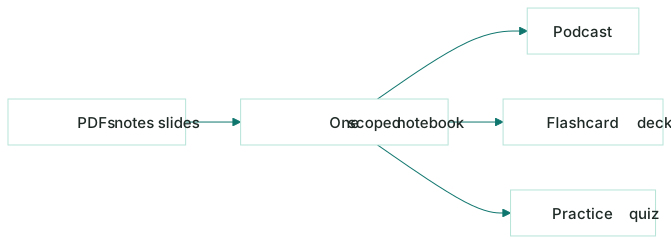
Tidy source in, focused study out
Here's the part people miss. With Kyonote, your notebook isn't just storage. It's the source for everything you study from.
Drop in your PDFs, paste your lecture notes, add your own slides, and the app builds study tools straight from that material:
- a two-host podcast that explains it,
- an audiobook read-aloud of your notes for hands-busy review,
- an auto-built flashcard deck for recall,
- a short practice quiz to find your gaps,
- and a longer mock exam for a real dry run before the test.
They all read the same notebook. So the cleaner that notebook is, the more focused those tools are.
A notebook scoped to one subject gives you a podcast about that subject, a deck about that subject, a quiz about that subject. Mix three courses into one notebook and your study set starts to wander. A flashcard from history shows up while you're trying to drill chemistry.
This is the quiet reason organizing matters more now than it did with paper. Messy notes used to just waste your time. Messy notes that feed a study tool waste your time twice: once finding things, once studying the wrong mix. Clean the source. The rest stays grounded on its own.
A simple structure that doesn't fall apart
You don't need a color-coded system you'll abandon by week three. You need a few rules you can keep half-asleep:
- One notebook, one scope. Subject or exam. Name it plainly so you can find it fast.
- Drop source in as it arrives. Got the lecture PDF after class? Put it in the right notebook that day, while you still remember which one it belongs to. This is the small habit that prevents the big pile. (More on that in what to do with your lecture notes after class.)
- Keep it to the real material. Slides, handouts, your own notes: the things you'll actually be tested on. Leave out the random screenshots and half-thoughts that don't earn their place.
- Split before it sprawls. When a notebook starts holding two different topics, make a second one. It's cheaper to split early than to untangle a mess later.
The goal isn't a beautiful system. It's a boring, reliable one. The kind that still works the week everything is on fire.
Naming and finding things later
A notebook you can't find isn't organized, it's just hidden. Name each one the way you'd search for it under pressure: the subject, and a hint of when. "Microbiology, Spring." "MCAT bio." Future-you, scrolling at 11pm, will thank present-you for not naming it "notes2final."
If two subjects always come up together in the same exam, it can be fine to keep them in one notebook, as long as that grouping is intentional, not accidental. The line to watch is whether the notebook still has one honest scope. The moment you can't summarize it in a phrase, split it.
Organized notes make active study easier
The real payoff of a tidy notebook isn't tidiness. It's that the hard part of studying gets easier to start.
When your source is scoped and clean, you're one tap from:
- a podcast for the first pass,
- a deck for active recall,
- a quiz to check yourself.
No hunting. No "wait, where did I put that handout." No gap between deciding to study and actually starting.
That matters more than it sounds. The methods that actually work, like testing yourself and spacing it out, are the ones we skip when getting started feels like a chore. Lower the friction and you do more of the good stuff.
So organizing isn't the boring chore before the real work. It's what makes the real work easy to start.
Putting it together
One notebook per subject or per exam. Only the real material inside. A plain name you can find later. Split it before it sprawls.
Do that, and your notes stop being a pile you dread and start being a source you can build on. Once your notebook is clean, there are three ways to study the same notes (listen, recall, test), each one grounded in exactly what you put in.
Start one notebook for your next exam, drop in the material, and see how much lighter the studying feels when the source is tidy.
Frequently asked questions
- Should I make one notebook per subject or per exam?
- Either works — pick whatever matches how your brain files things. One per subject keeps the whole course in one place all term. One per exam keeps things tight when you only care about what's on the test. The rule is one clear scope per notebook, not a junk drawer of everything.
- What can I put in a study notebook?
- In Kyonote, a notebook holds PDFs, pasted lecture notes, and your own notes or slides. You drop the source material in once, and the podcast, flashcards, and quiz are all built from it. Keeping the source clean is what keeps those tools accurate.
- Why does keeping my notes organized matter for AI study tools?
- Because anything built from your notes is only as focused as the notes themselves. A tidy notebook scoped to one subject gives you a podcast, deck, and quiz about that subject. A messy mix of three courses gives you a study set that wanders. Clean source in, focused study out.