
Study tips for high school students that actually help
Study tips for high school students that actually help: quiz yourself instead of re-reading, start in under a minute, and study in small focused chunks.
The study tips that actually help high school students are simpler than you'd think: quiz yourself instead of re-reading, start small so you don't put it off, and spread it over a few days. That's most of the game.
Here's the thing. Most of what gets passed around as study advice is highlighting, re-reading, and copying notes out neatly. It feels productive. It mostly isn't. Let's skip to what works.
Quiz yourself instead of re-reading
If you remember one thing from this post, make it this: testing yourself beats reading the same notes again.
Re-reading is the most popular way to study and one of the weakest. The words start to look familiar, so your brain says yeah, I know this. But recognizing a page isn't the same as recalling it in an exam. There's a full breakdown in why re-reading your notes doesn't work.
What works instead is active recall: close the book and try to pull the answer out of your own head. It's harder, and that's the point. The effort is what builds the memory. Researchers call this the testing effect (Roediger and Karpicke, 2006), and it's one of the most solid findings in all of learning science. More on it in active recall: the study method that actually works.
A simple way to do it tonight:
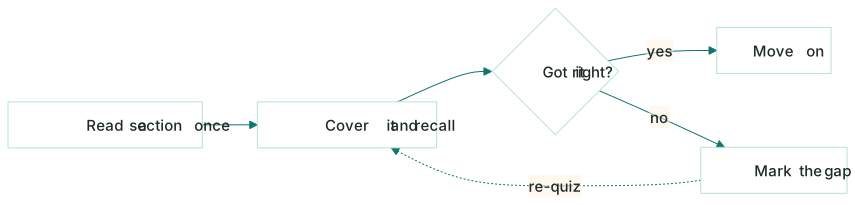
- Read a section once, then cover it and say or write what you remember.
- Check what you missed. That gap is your to-do list.
- Re-quiz only the parts you got wrong.
A wrong answer isn't a fail. It's the most useful thing a quiz gives you, because it points right at what to study next.
Start small so you actually start
The hardest part of studying isn't the studying. It's starting. I'll do my whole chem chapter tonight turns into scrolling your phone for an hour.
So shrink it. Tell yourself you'll do five minutes. Five questions. One flashcard run. That's small enough that there's no excuse, and once you start you usually keep going.
This works for most people. It's huge if you tend to put things off. If I'll start later is your default, how to stop procrastinating and actually start studying goes deeper on the trick of starting tiny.
Small sessions also fit into time you actually have:
- Five flashcards on the bus.
- A ten-minute quiz before a test.
- A quick recall while you wait for practice to start.
You don't need a free evening. You need the gaps you already have.
Spread it out instead of cramming
Cramming the night before is the classic move. It can scrape you a passing grade. But most of it is gone within days, which is brutal when finals come around.
The fix is spacing: same total time, just split across a few days. Twenty minutes Monday, Tuesday, and Wednesday beats an hour of panic on Thursday. Each time you come back and have half-forgotten something, pulling it back is what locks it in. That's the spacing effect, and you can read how to use it in spaced repetition: how to remember what you study.
There's a reason you forget so fast otherwise. Memory drops off a cliff right after you learn something unless you revisit it. That drop has a name and a fix in the forgetting curve, and how to beat it.
If a test snuck up on you and you only have a few days, there's still a smart way to do it in how to study for a test in one week.
Turn your notes into stuff you'll actually use
Here's where it gets easier. The slowest part of all this is making flashcards and writing practice questions by hand. That's also where most people give up.
This is the whole reason Kyonote exists. You make a notebook for a subject, drop in your class notes, a PDF, or your slides, and in about a minute it builds a study set from your exact material. Not random internet questions. Yours.
From one notebook you get:
- A short quiz at three levels: gentle to warm up, mixed, then hard to find the gaps before the exam does. Walk-through in quiz yourself before the exam does.
- A deck of flashcards built straight from your notes, so you skip the hour of typing cards. You flip and mark Got it or Again. See flashcards that build themselves.
- A two-host podcast that talks through your material like two people explaining it to you. Plays like normal audio, so you can speed it up or listen on the way to school. Here's how in turn any PDF into a podcast.
It's free to start on iPhone and Android. The point isn't more apps. It's getting the boring setup out of the way so you spend your time recalling, not making materials.
The study tips for high school students, put into a week-before plan
You don't need a fancy system. Here's a default you can copy.
| When | What to do | How long |
|---|---|---|
| 5 to 7 days out | Make a notebook, drop in your notes, run a gentle quiz | 15 min |
| A few days out | Flashcards in small gaps, plus a mixed quiz | 10 min each |
| Commute or chores | Listen to the podcast of the topic | 10 min |
| Night before | Hard quiz on the parts you keep missing | 20 min |
You won't do all of it every day, and that's fine. The trick is having a default for each kind of free moment so you stop deciding and just go.
If you want a fuller routine that holds up past one test, how to build a study routine that sticks lays it out.
Quick wins you can use tonight
A few small things that punch above their weight:
- Put your phone in another room while you study. Even face-down on the desk, it pulls your focus. More in how to focus while studying and avoid distractions.
- Explain it to someone, even an empty room. If you can't say it simply, you don't know it yet. That's the idea behind the Feynman technique.
- Mix up subjects in a session instead of one big block of one thing. It feels harder and works better, which is the point of interleaving: why mixing topics helps you learn.
- Sleep. A tired brain doesn't store memories well. A late night of cramming often costs more than it earns.
Start with your next test
Don't try to fix your whole study life tonight. Just pick the subject with the closest test, make one notebook, and drop your notes in.
In about a minute you'll have a quiz to run cold, flashcards for the bus, and a podcast for the walk home. Then let the small, often, quiz-yourself habit do the work. That's the version of studying that actually helps, and it's a lot kinder than another all-nighter.
Frequently asked questions
- What's the best way for high school students to study for a test?
- Quiz yourself instead of re-reading. Pulling answers out of your own head is what builds memory, and it shows you exactly what you don't know yet. Study in short sessions across a few days rather than one long night, and spend your time on the parts you keep getting wrong.
- Why doesn't re-reading my notes help me learn?
- Re-reading makes the words feel familiar, but familiarity isn't the same as being able to recall it on a test. You recognize the page without being able to produce the answer on your own. Quizzing yourself forces real recall, which is what actually sticks, so it beats re-reading almost every time.
- How can I study when I have almost no free time?
- Use small gaps instead of waiting for a free evening. Five flashcards on the bus, a ten-minute quiz before a test, and a podcast of your notes on the walk to school add up fast. Short and frequent beats one long cram session, and it's a lot easier to actually start.