
Study tips for law students: from outlines to recall
Study tips for law students: turn dense casebook reading into tight outlines, then flashcards, quizzes, and audio review so the rules actually stick.
The best way to study in law school is to turn your dense reading into tight outlines, then test yourself on those outlines instead of re-reading them. Outlining organizes the rules so you can actually use them, and active recall is what moves them into memory. These study tips for law students walk that path from the casebook all the way to exam-ready recall.
Law school study is its own beast. The reading is heavy. The rules are layered, and the exam doesn't ask you to recite black-letter law. It asks you to spot the issue and apply the rule to a messy fact pattern. So your study system has to do two jobs: get the rules into your head, and get you reps applying them.
Here's the path that works.

Start with the reading, but read for the rule
Casebook reading is where most of the hours go, so make them count. You're not reading a case to enjoy the prose. You're reading it to extract:
- The rule the court announced.
- The elements or factors that make up that rule.
- The facts that mattered to the outcome.
- How this case fits with the others in the section.
Brief cases short. A half-page is plenty for most. The long, color-coded brief feels productive, but it's the same trap as highlighting your whole textbook. Familiarity isn't memory, which is the core reason re-reading your notes doesn't work.
If the reading just isn't sticking no matter how slowly you go, that's a signal to change methods, not to read it again.
The outline is the core of study tips for law students
The outline is where you take a semester of cases and turn them into a usable map of the rules.
Don't wait until reading period. Outline as you go, ideally after each topic wraps up, so you're consolidating while it's fresh.
A good outline does three things:
- Organizes rules by topic and sub-topic, the way the exam will be structured.
- States each rule and its elements clearly, in your own words.
- Adds a line or two on how to apply it, plus the classic fact patterns.
Writing the outline yourself is half the value. The act of deciding what goes where forces you to understand the relationships between rules, which is exactly what you need on an issue-spotter. A borrowed outline skips that work, which is why it never sticks the same way.
Keep one notebook per class so the material stays sorted by what you're actually tested on.
Convert the outline into recall, not re-reading
Here's where most people stall. They finish a beautiful outline, then study by reading it over and over. That's the least effective thing you can do with it.
The fix is simple. Test yourself on the outline instead. Pulling a rule out of your own head is what builds the memory, not seeing it again on the page. This is the testing effect, one of the most reliable findings in learning research (Roediger and Karpicke, 2006).
There are two ways to turn an outline into recall, and you want both.
Flashcards for the rules you have to know cold:
- Elements of each claim or defense.
- Multi-part tests and the factors inside them.
- Standards of review, burdens, exceptions.
- Definitions that the rule turns on.
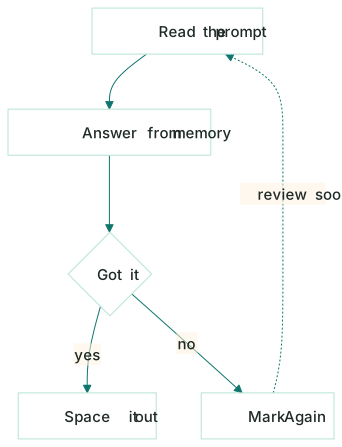
The slow part has always been making the cards. From a notebook in Kyonote, you can drop in your outline or class notes and it builds a deck of short prompts from that exact material, so you skip the hour of typing. Then the way you drill matters: read the prompt, answer from memory, then flip and mark "Got it" or "Again". That pause where you try to remember before flipping is the whole point. If hand-making cards has been eating your nights, flashcards that build themselves shows the shortcut.
Practice questions for applying the rules:
- A short quiz on a topic surfaces what you don't actually know yet.
- From the same notebook, Kyonote builds a quiz from your outline at three levels: gentle to warm up, mixed once you're steady, and hard to find the gaps before the exam does.
- A wrong answer isn't a setback. It's a map of what to review next.
For more on building this habit, see quiz yourself before the exam does.
Space your reviews across the semester
Cramming an outline the week before is the default, and it's why so much of it leaks out under exam pressure.
Memory fades on a predictable curve, and each time you recall something just before you'd forget it, the memory gets more durable. That's the spacing effect, and using it is far cheaper than re-learning everything in finals week. The mechanics are in spaced repetition: how to remember what you study.
In practice for law school:
- Drill a topic's flashcards the week you learn it, then again a week or two later, then before exams.
- Run a quick quiz on older topics so they don't go stale.
- By reading period, you're reviewing and applying, not learning the rules for the first time.
Use audio to keep outlines warm
Law students have dead time. The commute, the gym, the walk between classes. You can't read an outline there. But you can listen to it.
From the same notebook, you can turn your outline into audio two ways:
- An audiobook that reads your outline aloud, with the text highlighting along as it plays, good for a straight review of the rules.
- A two-host podcast that talks through your material in a back-and-forth that's easier to follow than a wall of text. Free episodes run up to 10 minutes, Pro up to 30. It plays like any audio player, with speed control, skip, and background play.
The important part: both come from your own files, not the open internet. So you're hearing your Con Law outline, not a generic explainer that drifts from what your professor will test. For the walk-through, see turn any PDF into a podcast.
Treat audio as a supplement that keeps the material warm between active sessions, not a replacement for flashcards and practice questions.
A simple weekly rhythm
You don't need a complicated system. You need a default for each kind of study time:
| When | What |
|---|---|
| As each topic wraps | Add it to the outline, build flashcards |
| Small gaps in the day | Drill the current deck, five cards at a time |
| Commute or walk | Listen to the outline as audio |
| End of each week | Quick quiz on older topics to keep them fresh |
| Reading period | Hard quizzes and timed practice on the gaps |
The goal is to stop deciding what to study and just study, so your scarce hours go to recall and application instead of one more read-through.
Start with your next outline
You don't have to overhaul everything tonight. Pick the class with the next exam, make a notebook, and drop in your outline or notes.
In about a minute you'll have flashcards for the rules, a quiz to find the gaps, and audio for the commute, all grounded in your own material. Then let the reps do the work. Outline, recall, repeat. Space it across the semester, and the rules are still there when the fact pattern shows up on exam day.
Frequently asked questions
- How should law students study for exams?
- Build outlines from your reading and notes, then test yourself on them instead of re-reading. Outlining forces you to organize the rules, and active recall through flashcards and practice questions is what makes them stick. Re-reading your casebook feels productive but does little, so spend your time pulling rules from memory and applying them to hypotheticals.
- What's the best way to memorize rules and elements for law school?
- Turn each rule, test, and element list into a flashcard and drill it across the semester. Pulling the elements of a claim from memory builds far stronger recall than reading the outline again. Spacing those reviews out over weeks, rather than cramming, is what keeps the rules available when you need them on the exam.
- Can I review my law outlines without reading them?
- Yes. You can turn an outline into audio and listen to it on a commute, a walk, or while doing chores. Hearing your own outline read aloud, or two hosts talking through it, is a good way to keep the material warm between active study sessions. It works best as a supplement to flashcards and practice questions, not a replacement.