
Interleaving: why mixing topics helps you learn
Interleaving means mixing topics and problem types instead of drilling one at a time. Here's why mixed practice beats blocked practice, and how to set it up.
Interleaving means mixing different topics or problem types in one study session, instead of drilling one kind until it's smooth and then moving on. So instead of twenty algebra problems followed by twenty geometry problems, you shuffle them together. It feels worse while you do it. That's part of why it works.
Most of us study the other way without thinking about it. We pick one topic, grind it until it feels easy, then move to the next. That's blocked practice, and it's comfortable. But comfort and learning often point in opposite directions.
Blocked practice vs interleaved practice
The difference is just the order you do things in.
Blocked practice groups the same type together: AAAA, then BBBB, then CCCC. You do one kind of problem over and over before switching.
Interleaved practice mixes them: ABCA, CBAC, BACB. Same problems, same total reps. Just a different order.
Here's the strange part: blocked feels better.
By your fourth algebra problem in a row you've settled into a groove. The answers come quicker, and your brain reads that smoothness as "I'm learning this."
But that smoothness is mostly short-term. You're not really retrieving the method each time. You're repeating one you already loaded.
The real test is whether you can still do it tomorrow, mixed in with everything else.
| Blocked practice | Interleaved practice | |
|---|---|---|
| Order | One topic at a time | Topics mixed together |
| How it feels | Smooth, easy, confident | Slower, harder, bumpy |
| Short-term performance | Looks great | Looks worse |
| Long-term retention | Often weaker | Often stronger |
| Picking the right method | Not really practiced | Practiced every problem |
Why mixing helps you learn
Two reasons, really:
- It forces you to pick the method. Blocked practice skips the hardest step on the exam: figuring out which approach even applies.
- It makes the differences obvious. When similar topics sit side by side, you actually notice why one calls for this rule and the next calls for another.
Take the first one. When you do twenty geometry problems in a row, you already know it's geometry. You never have to ask "wait, what kind of problem is this?" The worksheet told you.
But the exam won't. It hands you a mixed pile, and the first, hardest step is figuring out which method fits.
Interleaving forces that step every single time. Each problem, you size it up before you solve it. That's harder, and it's exactly the skill the test is checking. Researchers call this kind of useful struggle a desirable difficulty. The struggle is the point. It's not a sign you're doing it wrong.
The second reason is contrast. Drilling topics in separate blocks hides how they differ. Mixing them puts the differences under a spotlight, so you stop confusing the two.
All of this is tied to active recall, pulling an answer out of your head instead of recognizing it on the page. For the fuller version, active recall is the study method that actually works covers it.
What the research actually says
Interleaving is real, but it's been oversold in places. So here's the honest version.
Studies on math practice and on motor skills (sports drills, visual classification tasks) have repeatedly found that mixed practice beats blocked practice for two things:
- Long-term retention (what you can still do days later).
- Transfer, meaning handling new problems you haven't seen in that exact form.
There's a famous wrinkle: learners almost always predict the opposite. They feel like blocked practice worked better, even right after the interleaved group outscores them.
Now the fine print. Interleaving helps most when:
- The topics are related and easy to confuse.
- You already grasp the basics of each one.
Mix things that have nothing to do with each other, or mix before you understand any of them, and you don't get much. It's a tool for review, not for first contact with brand-new material.
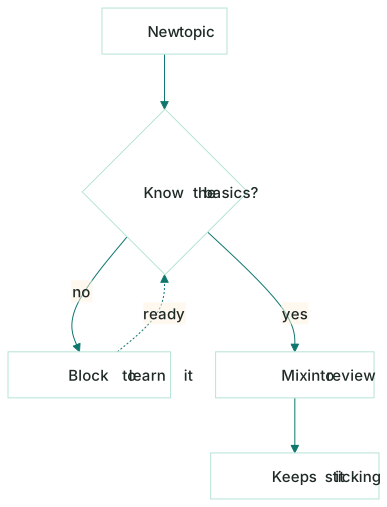
So the move is simple: learn the basics of each topic first, then mix them once you're reviewing.
How to interleave a quiz or a deck
You don't need a system for this. You need to stop sorting.
- Build one notebook, not five tiny ones. If three topics belong to the same subject or the same exam, keep them in a single notebook so your review naturally pulls from all of them. (More on this in organizing your study notes by notebook.)
- Let a quiz do the mixing. A practice quiz drawn from a full notebook hands you questions from across the material in no particular order. That's interleaving, automatically. It's the whole reason it's worth making a practice quiz from your own notes instead of re-reading.
- Shuffle one deck instead of running themed decks. Flashcards from a mixed notebook jump between topics as you flip, so you're forced to identify each card before you answer. You can let flashcards build themselves from your notes and review the whole set in one shuffled pass.
- Expect it to feel worse. This is the part people get wrong. Interleaved sessions feel slower and more error-prone than blocked ones. That feeling is not failure. It's the signal that you're doing the harder, more useful kind of practice.
When blocked practice still makes sense
Interleaving isn't a rule you follow everywhere. Sometimes a clean block is the right call:
- When a topic is brand new. You need a few reps to form the basic pattern before mixing makes sense.
- When you're making a procedure automatic. A specific formula or a verb conjugation is fine to drill in a row.
A simple rule of thumb: block to learn it, interleave to keep it. Do a short focused block when something's new, then fold it into your mixed review from then on.
That mixed review is where most of the durable learning happens. It pairs naturally with spacing your reviews out over time: mix the topics, space the sessions, and let it feel a little harder than you'd like. That discomfort usually means something's actually sticking.
Frequently asked questions
- What is interleaving in studying?
- Interleaving means mixing different topics or problem types in one study session instead of drilling one kind at a time. So instead of doing twenty of problem A, then twenty of B, you shuffle them: A, C, B, A, C. It feels harder, but it tends to make the learning stick and transfer better to new problems.
- Is interleaving better than blocked practice?
- For most skills that involve choosing the right method, yes. Blocked practice feels smoother in the moment, but research on motor skills and math practice has found interleaving leads to better long-term retention and transfer. The catch is it feels harder while you do it, so people often quit too early.
- How do I start interleaving?
- Pick two or three related topics you already understand the basics of, then practice them shuffled rather than one block at a time. A mixed quiz or a single shuffled flashcard deck does this for you automatically. Keep sessions short and don't worry that it feels slower than blocked drilling.