
The Cornell note-taking method, explained
The Cornell note-taking method, explained: the cue, notes, and summary layout, how to use it during and after class, and how to turn it into real practice.
The Cornell note-taking method splits your page into three parts: a wide notes column on the right, a narrow cue column on the left, and a summary strip along the bottom. You take notes on the right during class, add questions and keywords in the left column afterward, then write a short summary at the bottom. That left column is the whole point: it turns your notes into a ready-made quiz.
It's an old system, but it stuck around for a good reason. It builds the review step right into the page.
Here's how it actually works, and how to get more out of it than most people do.
The Cornell layout: cue, notes, summary
Take one page and draw two lines.
- A vertical line about a third of the way in from the left. The narrow strip on the left is your cue column. The wide area on the right is your notes column.
- A horizontal line a couple of inches up from the bottom. That bottom strip is your summary.
That's it. Three zones, each with one job:
- Notes column (right, during class). Your normal notes. Main points, key terms, examples. Don't try to fill the left column or the summary while the lecture is moving. You'll fall behind.
- Cue column (left, after class). Short prompts that point at the notes beside them. Keywords, or better, questions. Next to a paragraph on supply and demand, you might write "What shifts a demand curve?"
- Summary (bottom, after class). One to three sentences in your own words: what was this page about? If you can't write it, you found a gap.
The trick people miss: the left column and the summary aren't decoration. They're the part that does the learning.

How to use it during class vs. after
Cornell is really two activities, and keeping them separate is what makes it work.
During class, keep it simple. Only write in the right-hand notes column. Capture ideas, not a transcript. Leave white space so you have room to add things later. If you try to do clever cues live, you stop listening.
After class, do the review pass. This is where Cornell earns its keep. Ideally within a day, while it's still fresh:
- Read back through your notes column.
- In the left column, write a cue or question for each chunk.
- At the bottom, write your one to three sentence summary.
Filling notes during a lecture is mostly recording. Writing the cues and the summary afterward forces you to think about what the material actually means. Skip that part and you've got tidy notes and not much else.
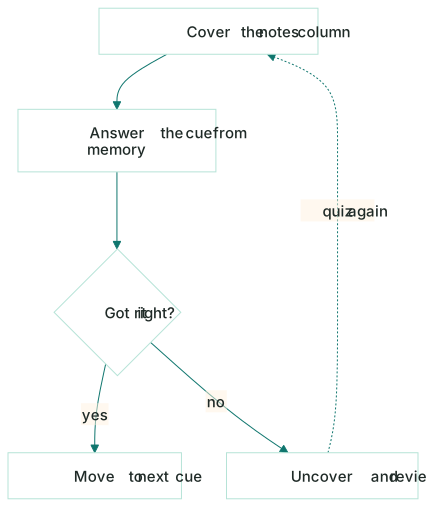
The cue column is a self-quiz in disguise
Here's the part that turns Cornell from "neat layout" into "actually helps you remember."
Cover the right-hand notes column with your hand or a sheet of paper. Look only at the cues on the left. Try to answer each one out loud or on paper from memory. Then uncover and check.
That's active recall. You're pulling the answer back instead of re-reading it. That one move is what makes things stick, and it's worth understanding on its own. See active recall: the study method that actually works.
Why this beats just re-reading your notes:
- Re-reading builds a familiar feeling. You recognize the words and assume you know them.
- Recognition is not recall. On the exam there's no page to recognize, only a question to answer.
- Pulling the answer from memory is the exact skill the test asks for, so practice it directly.
This is also why re-reading doesn't work no matter how many times you do it. The cue column exists precisely so you stop re-reading and start retrieving.
Build retrieval tools on top of your Cornell notes
The cue column gives you one self-quiz, on one page, on one day. But memory fades. Test yourself once and most of it is gone within days, which is the whole idea behind the forgetting curve.
So the real win is taking those cues and reusing them over time, spaced out, instead of cramming the night before. That's spaced repetition in plain terms: review just before you'd forget.
A few ways to turn Cornell cues into repeatable practice:
- Flashcards. Each cue is already a card front. The matching notes are the back. A deck you can shuffle and revisit beats a static page.
- A practice quiz. Group cues from a few pages into a short quiz so you test a whole topic, not one page at a time.
- Mixing topics. Once you have cards from several pages, pull from all of them in one session instead of one topic at a time. That's interleaving, and it makes recall harder in a useful way.
The catch is friction. After a full day of class, hand-copying every cue into flashcards is the kind of chore that quietly never happens.
That's the gap Kyonote closes. You make a notebook for the subject, paste in your notes or drop in the slides, and you get a study set in about a minute, grounded in exactly what you put in.
From that one notebook you get:
- Flashcards built from your material, so you flip and mark "Got it" or "Again".
- A short quiz at the level you pick: gentle, mixed, or hard.
- A two-host podcast that explains your notes, so you can review on the walk home.
So your Cornell cues become a deck you can run again next week, not a page you re-read once. See how the flashcards build themselves, and how the formats fit together in one notebook, three ways to study.
Common Cornell mistakes
A few easy ways to do it wrong:
- Filling the cue column during class. You can't take good notes and write good questions at the same time. Cues are an after-class job.
- Skipping the review pass. If you never go back to write cues and a summary, you've just drawn lines on a normal page.
- Re-reading instead of self-quizzing. The layout invites you to cover and recall. If you only re-read the right column, you lose the entire benefit.
- Doing it once and stopping. One quiz on one day won't hold. Reuse the cues over time.
The short version
The Cornell method is three zones on a page: notes on the right during class, cues on the left afterward, a summary at the bottom.
- Take notes only on the right while the lecture moves.
- Add cues and a summary within a day. That's the thinking step.
- Cover the notes and answer the cues from memory.
- Reuse those cues over time as flashcards or quizzes.
The layout is the easy part. The cue column is what matters, because it nudges you from re-reading toward retrieving, and retrieving is what learning actually is.
Frequently asked questions
- What are the three parts of the Cornell method?
- A wide notes column on the right, a narrow cue column on the left, and a summary strip across the bottom. You write notes on the right during class, add cues and questions in the left column afterward, then write a short summary at the bottom. The cue column is what turns your notes into a self-quiz later.
- When do I fill in the cue column and summary?
- Not during class. During class you only fill the right-hand notes column so you can keep up. The cue column and the bottom summary get filled in afterward, ideally within a day while it is fresh. That review pass is where most of the learning happens, not the writing during the lecture.
- Does the Cornell method actually help you remember more?
- The layout itself does not. What helps is what it sets up: covering the notes and answering the cues from memory is active recall, which is well supported by research like Roediger and Karpicke (2006). If you only re-read your Cornell notes, you get the same weak results as any re-reading. The cue column exists so you quiz yourself instead.