
The best AI study tools for turning notes into study sets
The best AI study tools turn your own notes into flashcards, quizzes, and audio. Here's what to look for, the traps to avoid, and how to pick the right one.
The best AI study tools take the notes you already have and turn them into things you can actually study from. Flashcards. Practice quizzes. Audio you can listen to. They don't just summarize your material back at you. That last part matters more than anything else, so it's where this whole guide starts.
There are a lot of these tools now, and most of them are some flavor of "upload a PDF, get an answer." That's useful, but it's not studying. Studying is the part where you pull the answer out of your own head. The tools worth your time are the ones that get you there faster.
Here's what separates a real AI study tool from a fancy summarizer, the traps to watch for, and how to pick the one that fits how you actually work.
What to look for in an AI study tool
Before you compare names, get clear on the criteria. Most "best AI study tools" lists rank features. The thing that actually predicts whether a tool helps you is narrower than that.
Here's what matters, roughly in order:
- Grounded in your own files. The tool should build from your notes, PDFs, and slides, not from whatever it scraped off the internet. You're being tested on your professor's material, not the average of the web.
- It makes you do the work, not watch it. Summaries feel great and teach almost nothing. The tools that work give you flashcards, quizzes, and self-testing. That's active recall, not passive reading.
- Fast setup. If it takes 20 minutes to get one study set, you'll do it once and never again. The good ones turn a file into a study set in about a minute.
- On your phone. Most studying happens in gaps (the bus, the line, the ten minutes before class). A tool that lives only on a laptop misses all of that.
- More than one way in. Hearing it, recalling it, and being quizzed on it each teach something different. A tool that only does one of those is doing a third of the job.
If a tool nails the first two, it's probably worth a look. If it misses both, it's a reading tool wearing a study-tool costume.
Grounded in your files beats trained on the internet
This is the single biggest split in the category, so it's worth slowing down on.
Some tools answer from a giant general model, basically a chatbot that read the whole internet. Others answer only from the specific files you give them. Both can sound smart. Only one is safe to study from.
Here's the problem with the internet-trained kind: it can be confidently wrong. It might give you the textbook definition when your course uses a different one, or invent a detail that isn't in your syllabus. On a casual question, no big deal. The night before an exam, that's a real risk.
When a tool is grounded in your notes, two good things happen:
- Everything it makes matches what you'll actually be tested on.
- It can't drift into facts your professor never taught.
So when you're evaluating anything in this category, the first question is simple: does this build from my material, or from the web? For more on why this matters, see how to study from a PDF without reading all of it.
The study methods that actually move the needle
A tool can be perfectly grounded and still waste your time if all it does is summarize. So the second filter is method. Does it push you toward the things research says actually build memory?
There are really three that matter, and the science behind them is solid and old:
- Active recall. Pulling an answer out of memory instead of re-reading it. This is the heavy lifter. Roediger and Karpicke's 2006 work on the testing effect showed students who tested themselves remembered far more a week later than students who just re-read. More on this in active recall, the study method that actually works.
- Spaced repetition. Reviewing at growing gaps so you catch each fact right as it starts to fade. It's the fix for the forgetting curve, and we cover it fully in the spaced repetition guide.
- Self-testing. Quizzing yourself before you feel ready, because the misses tell you exactly what to study next. See the testing effect, explained.
Notice none of these is "read a summary." Summaries help you get the shape of a topic on a first pass. They don't get it into long-term memory. If a tool stops at the summary, it's stopping at the easy, comfortable part, which is exactly the part that doesn't work.
So look for tools that make flashcards and quizzes from your material, not just bullet-point recaps.
Speed and mobile: the boring criteria that decide everything
The flashy features get the attention. The boring ones decide whether you'll actually use the thing.
Speed. Be honest about your own follow-through. If building a study set is a chore, it becomes a "later" task, and later never comes. The tools that stick are the ones where you drop in a file and have something to study a minute later. Low friction is what turns a good intention into a habit.
Mobile. Most of your study time isn't a clean two-hour block at a desk. It's scattered. The commute, the gym, the wait before a lecture. A phone app catches all of that. A web-only tool catches none of it. If you can study on your commute hands-free or listen to your notes on the go, you've found hours you didn't know you had.
Neither of these shows up on a feature checklist. Both of them are the difference between a tool you use for a week and one you use all term.
A simple way to compare the best AI study tools
You don't need a giant spreadsheet. Run any tool you're considering through these five questions. The more "yes" answers, the better the fit.
| What to check | Why it matters | What "good" looks like |
|---|---|---|
| Grounded in your files? | Keeps you on exactly what you'll be tested on | Builds only from your uploads, not the web |
| Makes you recall, not just read? | Active recall is what builds memory | Flashcards and quizzes, not only summaries |
| Fast to set up? | Friction kills the habit | A study set in about a minute |
| Works on your phone? | Catches the scattered study time | A real mobile app, not just a website |
| More than one way to study? | Listening, recall, testing each teach differently | Audio plus flashcards plus quizzes |
A tool that's a "yes" on the first two is already useful. A "yes" on all five is rare, and it's what you're aiming for.
Where Kyonote fits
Full honesty: Kyonote is one of these tools, so read this with that in mind. We built it around the criteria above, because those are the ones that decided whether we kept studying.
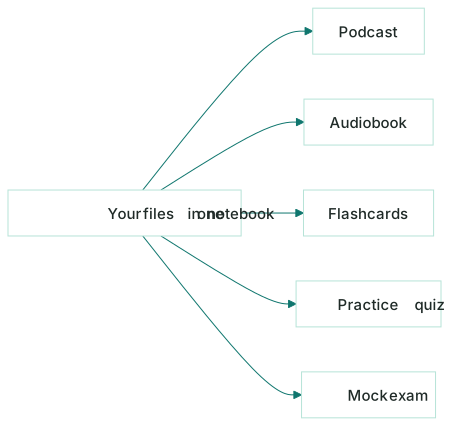
Here's how it works. You make a notebook, one per subject or exam, and drop in your PDFs, lecture notes, and slides. From that one notebook, grounded in only your files, Kyonote builds five things:
- A two-host podcast that explains your material like a conversation. Good for the first pass on a walk.
- An audiobook read-aloud of your notes, with the text highlighting as it plays, for hands-busy review.
- Flashcards that build themselves for active recall, so you skip the typing and get straight to retrieving.
- A practice quiz at three levels (gentle, mixed, hard) to find your gaps.
- A longer mock exam for a realistic dry run before the real thing.
It's free to start on iOS and Android, with Pro raising the limits for heavier use. The whole point is the first two criteria: everything stays grounded in your own material, and it pushes you toward recall and testing instead of re-reading. Drop in a file and see what it makes.
Pick the one you'll actually open
The "best AI study tools" debate gets overcomplicated. Strip it down and it's two questions: does it build from your own notes, and does it make you do active recall instead of just reading? Everything else (speed, mobile, variety) is about whether you'll stick with it.
A perfect tool you abandon in week two beats nothing, but only barely. A decent tool you open every day beats all of them.
So don't over-research this. Pick one that's grounded in your files and pushes you to recall, make sure it lives on your phone, and start. The studying matters more than the tool. If you want help building the habit around it, a study routine that sticks is the next thing to read.
Frequently asked questions
- What makes an AI study tool actually good?
- The big one is grounding: it should build everything from your own notes and files, not the open internet, so you practice exactly what you'll be tested on. After that, look for the study methods that move material into memory — flashcards, quizzes, and audio review — plus speed and a phone app you'll actually open. A tool that only summarizes is a reading tool, not a study tool.
- Are AI study tools worth it, or should I just make my own flashcards?
- Making your own cards has some value, but most people quit because it takes forever, and a half-built deck helps nobody. A good AI tool removes the setup so you spend your time on the part that works: retrieving answers from memory. The win isn't that it studies for you — it's that it gets you to active recall faster.
- Is it safe to use AI tools for studying?
- It's fine as long as the tool stays grounded in your own material instead of inventing facts from the open web. The risk with general chatbots is they can sound confident and be wrong. Tools that build only from the files you upload keep you practicing on your real coursework, which is what you want before an exam.