
NotebookLM vs Kyonote: which fits how you study?
NotebookLM vs Kyonote, compared honestly. One's a desktop research tool with an audio overview; one's a mobile study app. Here's which fits how you study.
Short answer: NotebookLM is a desktop-first research tool that turns your sources into notes plus an audio overview. Kyonote is a mobile study app that turns one notebook into a podcast, flashcards, a quiz, and more. They overlap on the "talk to my documents" part, but they're built for different moments. NotebookLM helps you research and understand. Kyonote helps you drill and remember.
So this isn't a "who wins" post. It's a "which one matches how you actually study" post.
Let's keep it honest and concrete.
The 30-second version
- NotebookLM is Google's research and note-taking tool. You add sources, ask questions, get summaries, and generate an Audio Overview that sounds like two hosts talking about your material. The workflow is built mostly for a browser at a desk (check their current apps, since this changes).
- Kyonote is a study app for your phone. You make a notebook, drop in PDFs or notes, and it builds a study set: a two-host podcast, an audiobook, flashcards, a quiz, and a mock exam, all grounded in your files.
- Both stay inside your own material instead of pulling from the open web. That's the shared idea.
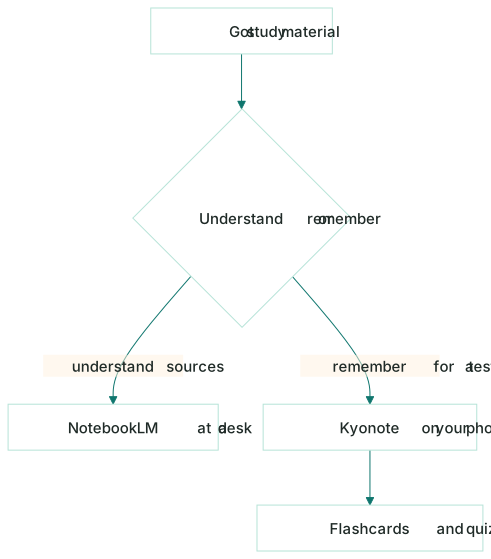
- The split: NotebookLM is built for understanding sources. Kyonote is built for the part after, where you have to get it into your head and keep it there.
Both tools change often, so treat any specific feature or limit here as "check their current version".
What NotebookLM is good at
NotebookLM shines when you're sitting down to make sense of a pile of material.
- You can load a bunch of sources and ask questions across all of them.
- It gives you grounded answers with citations back to where it found something.
- The Audio Overview turns your docs into a conversational rundown you can listen to.
- It's strong for research, synthesis, and "what does this set of documents actually say".
If your task is "I have ten readings and I need to understand the big picture," that's right in its lane. It's a thinking-and-reading tool, and it's good at it.
The catch for studying: understanding isn't the same as remembering. Reading a great summary feels like progress. But recognizing an idea on a page is not the same as pulling it out of a blank head on exam day. That gap is exactly why re-reading doesn't work.
What Kyonote is good at
Kyonote starts where studying gets hard: turning material you sort-of-know into stuff you can recall under pressure.
From one notebook, you get five things, all built from your own files:
- A two-host podcast. A conversation that explains your notes, so you can turn any PDF into a podcast and listen on the walk to class. Free episodes run up to 10 minutes, Pro up to 30.
- An audiobook. A clean read-aloud of your notes with the text highlighting along, for hands-busy review.
- Flashcards. A deck that builds itself from your notes so you flip a card and mark "Got it" or "Again".
- A quiz. A short practice quiz at three levels (gentle, mixed, hard) to find your gaps.
- A mock exam. A longer, exam-style run for a realistic dry run before the real thing.
That last group, flashcards and the quiz, is the part that makes studying actually work. Pulling answers out of your own memory is one of the most reliable ways to learn (the testing effect, Roediger and Karpicke 2006). Kyonote is built around that loop, not just the read-and-understand part.
The honest tradeoff: Kyonote isn't a research desk. You won't sit and interrogate a 200-page corpus across ten sources. It's for taking what you need to learn and drilling it.
Side by side
| NotebookLM | Kyonote | |
|---|---|---|
| Main job | Research and understand your sources | Drill and remember your material |
| Built for | Desktop, at a desk | Mobile, on the go |
| Audio | Audio overview of your sources | Two-host podcast plus an audiobook |
| Flashcards | Not the focus | Yes, auto-built, flip and mark |
| Quizzes | Not the focus | Yes, three difficulty levels |
| Mock exam | No | Yes |
| Grounded in your files | Yes | Yes |
Treat this as a snapshot. Both products ship updates, so check the current feature lists before you decide.
So which one fits you?
Pick based on the moment you're usually in.
- You're doing research or making sense of dense sources at a desk. NotebookLM. Load your documents, ask questions, listen to the overview.
- You already know what you need to learn and now have to memorize it for a test. Kyonote. Make a notebook, get flashcards and a quiz, and run the active-recall loop on your phone.
- You mostly study in spare minutes (commute, line, between classes). Kyonote is mobile-first, so making and reviewing a study set on your phone is the whole point.
- You want a study system, not just a smarter reader. Kyonote's flashcards-plus-quiz loop is built around how memory actually works, which you can read more about in active recall, the study method that actually works.
Honestly, plenty of people could use both. Research and outline in NotebookLM, then drop the same notes into Kyonote to turn understanding into recall. They're not really competitors so much as two halves of a study week.
The short version
NotebookLM is the better fit when the job is understanding a body of sources, especially at a desk. Kyonote is the better fit when the job is remembering your material and you live on your phone.
Ask yourself one thing: am I trying to understand this, or trying to remember it? That answer points you to the right tool faster than any feature list.
If it's the remembering part, drop a file into a notebook and see what comes out in about a minute.
Frequently asked questions
- Is Kyonote the same as NotebookLM?
- No. NotebookLM is Google's research tool: you add sources, ask questions, and get notes plus an audio overview, mostly on desktop. Kyonote is a mobile study app that turns one notebook into a two-host podcast, flashcards, a quiz, an audiobook, and a mock exam. Different jobs.
- Does NotebookLM make flashcards and quizzes?
- NotebookLM is built around research and an audio overview, not a flip-and-quiz study loop. Kyonote's whole point is the study set: from one notebook you get flashcards you flip and mark, plus quizzes at three difficulty levels. Check each tool's current features, since both keep changing.
- Which is better for studying on my phone?
- Kyonote is built mobile-first, so making and reviewing a study set on your phone is the main flow. NotebookLM is desktop-first and great for digging into sources at a desk. If most of your studying happens on the go, the mobile app fits better.